
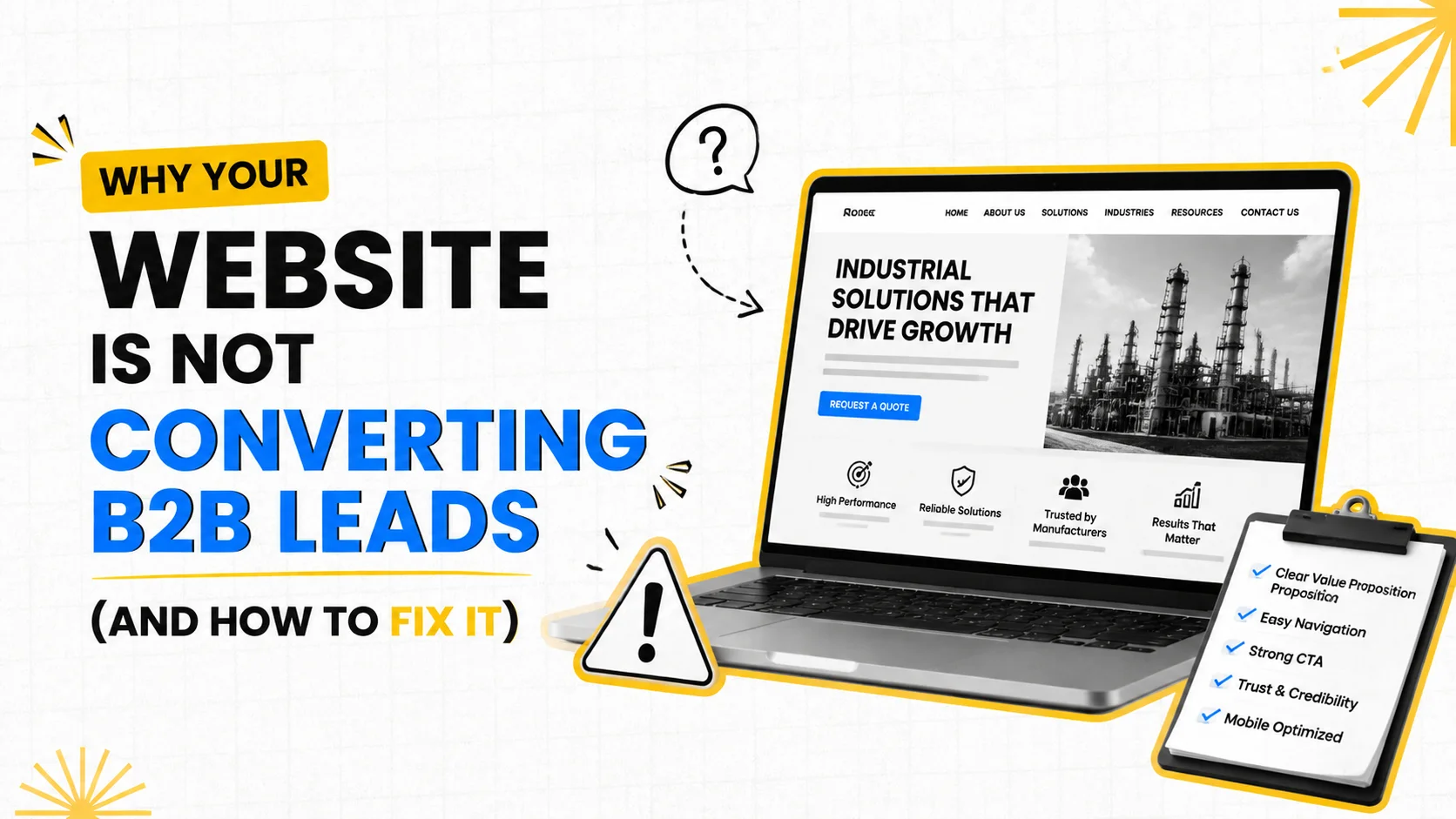
Introduction
Most B2B companies struggle with the same issue: traffic is coming in, but leads are not.
You may already be investing in SEO, ads, and LinkedIn campaigns, yet your website still fails in generating inquiries. This is a classic case of weak B2B website conversion optimization.
A website is not just a digital presence. It is a conversion system. Without proper structure, messaging, and trust elements, even high traffic does not result in leads.
The real goal of any B2B lead generation website is not just to attract users, but to convert them into qualified business opportunities.
The Real Cost of Poor Website Conversion
When conversion performance is low, business growth slows down even if traffic increases.
A weak B2B website conversion rate directly impacts:
- SEO ROI
- Paid ad performance
- Sales pipeline quality
- Overall marketing efficiency
For example, if your website gets 10,000 visitors:
- At 0.5% conversion → 50 leads
- At 2% conversion → 200 leads
This is why B2B conversion rate optimization often delivers faster business impact than increasing traffic.
Why B2B Websites Fail to Convert Leads
Unclear Value Proposition
One of the biggest reasons companies fail at B2B website optimization is unclear messaging. Visitors should understand your offering within seconds, otherwise they leave.
Generic statements like “we provide quality solutions” do not work in B2B environments. Buyers expect clarity, industry relevance, and direct value communication.
A strong message improves B2B lead conversion by immediately aligning with user intent.
Weak Call-to-Actions (CTAs)
Without clear guidance, users do not take action. A B2B lead generation website must always guide users toward the next step.
Effective CTAs include:
- Request a Quote
- Book a Demo
- Talk to an Expert
- Download Brochure
Weak CTAs reduce conversion opportunities significantly.
Lack of Trust Signals
Trust is a major factor in B2B website conversion optimization. Buyers rarely convert without validation.
Missing elements include:
- Client logos
- Case studies
- Testimonials
- Certifications
Without these, even interested visitors hesitate to take action.
Poor Website Experience
User experience plays a direct role in B2B website conversion rate performance.
Common issues include:
- Confusing navigation
- Cluttered layout
- Mobile usability problems
These issues increase drop-offs and reduce engagement.
Slow Website Performance
Speed affects conversion directly. Even small delays reduce engagement and increase bounce rates.
A slow B2B lead generation website often loses potential customers before they even explore services.
Generic Messaging
Many companies fail because they do not align messaging with buyer intent.
Instead of saying:
- “Best solutions in the market”
Use:
- Industry-specific outcomes
- Problem-solving statements
- Clear benefits
This improves B2B website optimization and engagement.
Complicated Lead Forms
Long forms reduce conversions. A strong B2B conversion rate optimization strategy always simplifies lead capture.
Best-performing forms include only essential fields:
- Name
- Company
- Requirement
No Buyer Journey Alignment
A B2B website conversion optimization strategy must support every stage of the buyer journey:
- Awareness → Educational content
- Consideration → Case studies and comparisons
- Decision → RFQ and consultation pages
Without this alignment, users drop off early.
Signs Your Website Has Conversion Problems
If your website has these issues, your B2B website conversion rate is likely low:
- High bounce rate
- Low inquiry volume
- Poor engagement
- Short session duration
- Low form submissions
These are clear signals that B2B website optimization is needed.
How to Fix B2B Website Conversion Problems
Improving performance starts with clarity and structure.
Your homepage should immediately explain what you do, who you serve, and why you are different. This is the foundation of B2B website conversion optimization.
Strong CTAs must guide users at every stage. Without direction, even interested visitors leave without converting.
Trust-building elements such as testimonials, certifications, and case studies increase confidence and improve B2B lead conversion rates.
Website experience should be smooth across devices. A fast, mobile-friendly interface improves engagement significantly.
Landing pages should be created for specific services and industries instead of relying only on general pages. This is a core part of B2B website optimization.
Lead forms should be short and friction-free. Every extra field reduces conversion probability.
Case studies are especially powerful because they demonstrate real results and improve trust.
Tracking tools such as heatmaps and analytics help identify user behavior and improve B2B conversion rate optimization over time.
B2B Conversion Rate Benchmarks
Most websites fall within these ranges:
- Average B2B website conversion rate: 1% – 3%
- High-performing websites: 3% – 5%
- Optimized landing pages: 5% – 10%
Even small improvements in B2B website conversion optimization can significantly increase revenue without increasing traffic.
Website Conversion Audit Checklist
A strong B2B lead generation website typically includes:
- Clear messaging above the fold
- Strong CTAs on all pages
- Fast loading performance
- Trust elements (logos, testimonials, certifications)
- Simple lead forms
- Industry-specific landing pages
- Proper tracking setup
These elements ensure consistent B2B lead conversion performance.
Conclusion
If your website is not converting, the problem is not traffic it is structure and optimization.
Effective B2B website conversion optimization focuses on clarity, trust, speed, and user experience. A strong B2B lead generation website does not just attract visitors; it converts them into qualified opportunities. Visit us.
By improving messaging, CTAs, landing pages, and tracking systems, businesses can significantly increase B2B lead conversion without increasing marketing spend.

